Five Cents Ten Cents

Showing posts with label financial freedom in singapore. Show all posts

Friday, April 4, 2008

Five Cents Ten Cents has moved to a dot com domain


Flickr! photo by *Micky.

Dear friends,

Five Cents Ten Cents continues to bring to you the principles of financial freedom in our new website at http://fivecentstencents.com

  • Living within your means
  • Saving and investing
  • Growing your means
It explores the journey towards financial freedom and how we can take specific actions to live our lives in accordance to what we want to achieve.

Each of us has to determine the path that we lead. The road that we travel. The steps that we will take.

Continue this journey with me in http://fivecentstencents.com.

Be well and prosper.

Tuesday, March 18, 2008

Five Cents Ten Cents is under-going a transformation... Watch for it!

Dear faithful readers,

It's been a almost a year since I started out  of my blog on financial freedom Five Cents Ten Cents and I have learnt so much from writing out my ideas relating to financial freedom!

The journey towards financial freedom is just starting to get interesting as now I have one more mouth to feed. :-)

Besides starting to pick up the ropes on parentcraft, I have also been exploring ways to bring this blog to the next level. I have been brainstorming and coming up with ideas on how I can TRANSFORM Five Cents Ten Cents into something even better!

I will continue with the tradition of sharing with you my insights and experiences about my own journey towards financial freedom while you accompany me through this blog.

In so doing, I hope that you find value through the ideas and thoughts generated about personal finance and YOU TOO can achieve financial freedom LONG BEFORE YOUR STATUTORY RETIREMENT AGE!

Watch this space over this coming weekend.

Be well and prosper.

Monday, March 17, 2008

Panzer's Quest for financial freedom

The picture above shows the token of appreciation given by the Singapore Armed Forces to me last year when I completed my 10 years of reservist duty to the State as a Conscript in the Lion City. It comprises a Hamilton Khaki watch, a collar pin and a medal as a form of recognition of my services to the nation.

The watch's face is broken after being worn for 1+ year while I have consigned the box to the depths of my cupboard to gather dust as a remembrance of something I would rather forget.

My quest for financial freedom
The relentlessness of my pursuit of financial freedom is to some extent driven by my experiences as a conscript in the Lion City. As a able and fit male citizen of Singapore, I went through two and a half years of full-time military service when I was 18 and this was followed up by 10 years of annual in-camp training that ranged from short two day BCTC courses revising basic infantry techniques to 3 week long operational duty at key installations in Singapore.

Whilst I was on reservist, I saw how my responsibilities were taken away from me and given to a lady staff who did not have reservist. That meant my performance for that year was impacted since a key work area was taken out of my hands and given to someone else. Over the internet, I read of anecdotes where Singaporean staff were discriminated by some employers as PRs or foreign talent were preferred for their lack of NS liabilities. There were even reservists who were afraid of changing jobs because they were on remedial training for failing their individual physical proficiency test (IPPT).

Recently, I read of a case where a NSF lost 85% of his sight due to oversight by his superiors and allowing his eye condition to worsen.

The reality is that as an NSmen, you are disadvantaged economically against your competitors in the career arena. Ceteris paribus, an employee who does not have NS liabilities i.e. Permanent Residents or foreigners on employment passes / work permits are more attractive to hire and retain than Singaporean men. That is the BRUTAL TRUTH that is Singapore Inc.

Yes, the gahmen gives you NSmen tax reliefs and top ups. Reliefs and top-ups help little when you don't have a job or when your job is at risk due to your NS liability. Safra clubs does little for you if you cannot afford to pay its subscriptions without a career.


Forget duty, honour and country, and let's talk about growth, GDP and money!
The relentlessness in which this administration pursues economic growth tells us one thing. Making money in Singapore Inc is the reason we exist. I believe in economic growth. What I don't believe in is a system that penalises its own male citizens with conscription which provides inadequate compensation mechanisms for the risks we take. Hence, now that I have served my duty to the country, it's time for my duty to my family to maximise our family's economic growth through making more money.

Volunteerism? Donations?... Been there and done that.

Now it's time for living within my means, saving and investing and growing my means.

Singapore Inc has abolished estate duty, so you can leave it ALL to your family so let's make economic hay while the sun shines.

My pursuit of financial freedom is to truly contribute to the country through taxes and to receive through income streams from career and investments. It is a win-win arrangement that no true economic maximiser will refuse.

After all, "welfare" IS a DIRTY word in Singapore.

Be well and prosper.

Friday, March 14, 2008

Financial freedom: Investing for the future, focussing on the present

I have discussed how the dream or reason that drives you towards financial freedom is important in focussing your hearts, minds and souls towards your financial goals.

Investing for the future, focussing on the present

You are not a robot following a program mindlessly and executing tasks repetitively. You are a human being filled with emotions, feelings and moods. In order for you to invest for the future, you need to focus on the present, to do the things daily that leads you surely and steadily towards your goals in financial freedom. You need to have a strong sense of purpose behind why you are pursuing the tasks and activities that move you towards financial freedom.

Let's recap what does financial freedom means to you:

To be able to have the targetted investible savings that generates passive income that exceeds our living expenses.

It's that simple. To be financially free you need to live within your means, save and invest and grow your means. This will help you generate sufficient investible savings over time which earns sufficient passive income to cover your living expenses. When you achieve that, you are no longer trapped in the time-money trade-off since you are free to spend your time to do whatever you want as your investible savings works for you to earn that income while you are sipping coffee watching the world go by during weekday mornings. ;-)

Focussing on the present means translating the financial freedom principle of living within your means, saving and investing and growing your means into daily achievable actions. Plans without action gets us nowhere. Action with plans gets us somewhere but not where we want to go.

Focussing on the present: getting you moving towards financial freedom

I like blogging because I have enjoyed writing and public speaking ever since I became a toastmaster. Blogging is also cathartic for me, i.e. it allows me to articulate my thoughts and at times vent off some frustrations in life. It also helps me to clarify my thoughts. I have made blogging my hobby because unlike other hobbies, blogging with AdSense helps me grow my means. I earn literally five cents ten cents everyday that adds up for my daughter's college tuition fund. This is one way where I am growing my means even as am a salaryman.

Living within my means comes from realising that materialism will only satisfy you briefing before the you hanker for the next "thing" to make you feel happy! Thus, a life spent chasing after materialism will never satisfy in my own experience. I realise that as the number of candles on my birthday cake grows, the more I realise happiness comes from the basics of health, happiness and family. Small luxuries now and then make life more enjoyable truly but they are to be sampled sparingly so as to preserve the delicate sweet flavour. Indulging in luxuries all the time spoils out palate and makes for one to live beyond your means.

Saving and investing comes from every small step. Yes, interest rates are pathetically low now. Singapore fixed deposits are yielding close to 1% plus. But that is no excuse to be saving even as inflation wipes out our savings, to mitigate the effects of inflation is just one way to take concrete action not to let our monies wither away at 0.25% in bank savings.

Investing in the future is to act in the present

You can achieve financial freedom. It is within our grasp by taking hold of our present and making small changes to our lives to align our mission, vision and values towards those conducive towards financial freedom. I took initial steps years ago and made a conscious decision to pay off my loan aggressively. Now I can concentrate on fatherhood and work-life balance and invest in the bringing up of my daughter as the roof over our heads belongs to us and not the bank! I am working for my daughter and family now and know that every bit of passive income I generate will go into building up financial freedom for my family and myself.

Be well and prosper.

Thursday, March 13, 2008

Financial Freedom: Drinking Coffee While the World Goes By

My good friend once remarked that once he had achieved financial freedom, he would want to spend his time drinking a leisurely cup of coffee on weekday mornings and watch the morning crowd pass him by as they go about working for a living.

Such is his dream and to some extent it is mine as well! :-)

What is your dream that drives you towards financial freedom

I encounter many posts in internet investment and personal finance forums from people who ask for the best investment that yields the highest returns in the shortest possible time. Others ask how they can save and invest without sacrificing their lifestyle that involves shopping, eating at restaurants and supporting a car.

They have a dream to drive a fancy car, to dine in nice restaurants and to be RICH with a capital "R".

Your dream can drive you towards the pinnacle of success or it can drive you crazy with the frustration of impotence in achieving your goals of being RICH.

But just dreaming of being RICH does nothing for us unless it spurs us on to take concrete action. The dream does nothing for us if it is the mere accumulation of material possessions for us to show off that we have MADE IT and are RICH.

My dream is to be financially free. Being financially free doesn't involve wearing bling-bling and brandishing the latest Rolex watch. It is not about the car I drive or the home I stay in. It is about escaping from the time-money trade-off. It is about being able to spend quality time with my daughter when I choose to. It is about being in control of HOW I can maximise the life in my years.

your dreams are your goals in the ideal state

Your dreams are actually your goals in an idealised state. Every endeavour begins in the mind. It comes from the conscious and the sub-conscious mind. In order for you to achieve your dreams, you have to sacrifice and make changes for you to hit the ideal state. Along the way, we either lower our dreams or uplift our lives to meet the lofty targets that we set for ourselves.

My dream is simple but yet challenging. It is to escape the time-money trap that engulfs all of us who work for a living. The escape route is laid out in front of me through my goals set in being financially free. I know how much investible savings I need to be able to sustain my current standard of living. I know what it takes to get there. And I know it takes me time, effort and perseverance to reach my dream.

I will get there because I am focussed, determined and patient. I will get there because that is what I dream about. I will get there because I am willing to do what it takes to live within my means, save and invest and to grow my means to get there.

You can do so too, if you truly believe in your dream.

Be well and prosper.

Wednesday, March 12, 2008

Financial Freedom: Plan-Do-Check-Act

In order for you to achieve financial freedom, you have to have a system in place to guide your decisions to live within your means, to save and invest and to grow your means. One way to develop a framework to apply the principles of living within your means, saving and investing and growing your means is the PLAN-DO-CHECK-ACT approach.

PDCA Approach (Deming Cycle in Quality Movement)
The Plan-do-check-act or PDCA approach is described by Wikipedia as, "... an iterative four-step problem-solving process typically used in quality control. "

It covers the following areas:

"PLAN

Establish the objectives and processes necessary to deliver results in accordance with the specifications.
DO
Implement the processes.

CHECK
Monitor and evaluate the processes and results against objectives and Specifications and report the outcome.

ACT
Apply actions to the outcome for necessary improvement. This means reviewing all steps (Plan, Do, Check, Act) and modifying the process to improve it before its next implementation."

How do we apply PDCA to our objective of achieving financial freedom?

1) Plan
You need to have an objective. Be specific and it should be something along the lines of, "I want to have $500,000 investible savings by age 50" for example. You need to develop the way or steps that will help you achieve your objective. These are the processes referred to in the PDCA approach.

2) Do
Action is paramount in any endeavour. But blind action without any pre-conceived notion of where you want to go and what you want to achieve will lead you nowhere. Action to implement the plan in the required steps (plus some variations along the way) take you bit by bit from where you are now, towards where you want to be in terms of achieiving financial freedom.

Let's say your target is to have $500,000 in investible savings by age 50. If you are now 30 years old, you have 20 more years to achieve this. $500k over 20 years = $25,000 a year. How do you save $25,000 a year? By first saving $1,000, $2,000, $5,000 a year etc and leveraging on the power of compound interest to help you. Will it be easy? Of course not! It will be challenging and tough if you do not believe in the principles of living within your means, savings and investing and growing your means. TOTO and 4D may bring you there maybe with a one in a billion chance but growing your investible savings at rates of 4% to 10% is possible but tough. It requires dedication, hard work and perseverance.

3) Check
As each year goes by and the number of candles on your birthday cake grows, how do you check if you are on track towards what you planned? Is your networth growing bigger, smaller or the same? Why is it? Analyse, think and critique yourself. If you have someone who you can trust and who is financially savvy, talk to them, or better still, read my blogs! :-)

Taking time to review how you have fared in your journey towards financial freedom is also important as periodic self-assessments give you some indication if indeed there is progress. More importantly, if you are not on track, you still have time to do something about it.

4) Act
Take corrective action if you are not doing so well according to your targets. Continue to do the same things if they are giving you the returns and growing your networth towards where you want it to be.

In the end, you continue with this cycle and continue to press on in your quest towards financial freedom. While doing so, don't forget to smell the roses and appreciate the small luxuries that life has to offer!

Be well and prosper.

Saturday, March 8, 2008

What is your reason for financial freedom?

If you have been following my blog, you would have read about how "what drives you" in your endeavour towards financial freedom is important in whether you will take concrete steps towards achieving financial freedom.

My daughter was born a few days ago and she would like to share a message with all of you.

She is my reason for financial freedom. ;-)

What is your motivation behind achieving financial freedom?

Why do you want it so much?

What will you do to MAKE IT HAPPEN?

Be well and prosper.

Sunday, March 2, 2008

Financial Freedom: Exploring and Trying New Frontiers

One of the key challenges of becoming financially free is to push beyond the confines of our existing boundaries. To be financially free is to adopt a mind-set that is somewhat different from the crowd. I remember some of the lessons shared by authors of "The Millionnaire Next Door" where they interviewed many millionnaires, i.e. those who had amassed $1million or more in assets other than their residential homes.

It was found that the majority of these were self-made millionnaires who owned their own businesses and were the typical frugal and thrifty hardworking folks who has some common characteristics.

One of the major characteristic (besides them being millionnaires!) was that most of them believed in saving and investing.

What does the crowd believe in?
Spending is sexy. Why are banks able to make money from pushing unsecured credit to you? Balance transfers, minimum payments, roll-overs all make it easy for you as the consumer to spend, spend and spend!

Look at the many advertisements in print, in television and on the internet. What do they encourage you to??? S-P-E-N-D...

Stretch your loan to the maximum. Conventional wisdom is for those with HDB concessionary rental rates of 2.6% to spread it out over 30 years. This is because you can "invest" to get a better return than 2.6%. I've discussed this topic whether to pay off your housing loan in an earlier post and it depends on computing your outstanding interest expense vs realised returns from investments at any point in time. Generally, if your interest expenses exceed your interest returns, you should generally try to pare down your debt within your means.

Get a set of wheels at the same time as you get your first job! Driving is cool, taking public transport sucks. I endured the sucky MRT, Bus and taxi services for a decade or more before I decided to buy a car because I was only responsible for transporting myself for the first phase of my life. But now I need to ferry 3 other persons besides myself from point A to point B and a car, while being more expensive than public transport, serves the transportation need better.

Going against the crowd

To go against the crowd is to save every month as far as possible. Delay your wants for today for tomorrow's needs. Saving is the new sexy attitude to have if you want to achieve financial freedom.

Paying down your loan or minimising debt. You need debt to finance our homes as you need a roof over your head. However, be aware of how fast the interest on this debt generates even more interest because of the power of compounding. I know of people who still owe the bank or HDB money even when they have retired from their jobs but they own cars. It is not unusual that even in 25-30 years if we do not make a conscious effort, we still end up being in debt because of the choices we make.

The attitudes and conventional wisdom presents itself as the boundary we have to break free of in order to get ourselves in the position to aspire towards financial freedom. If we continue to be trapped in the work-earn-spend-no savings-cycle then we doom ourselves to a lifetime of slavery to our jobs, our bosses and our financially captive lives.

Breaking free requires new mindsets.

Breaking free requires being an independent thinker.

Breaking free requires STRONG DESIRE.

Be well and prosper.

Saturday, March 1, 2008

Financial Freedom: Reading and understanding more about savings and investments

Have you ever bought a bottle of wine from the supermarket, wine shop or duty-free at Changi Airport?

Do you read the labels on the wine to understand what have you bought?

For many years, I didn't really read the labels because I didn't understand what they described until I attended a couple of wine appreciation courses where the speaker shared with us how to read the labels. For example, the label above reads "Cabernet Sauvignon" which is a widely recognised and grown red wine grape variety. Wine labels go by grape variety or region or name of the winery and different types of wine have different types of labelling conventions based on country, custom and marketing.

Reading about savings and investments: Know what you are investing in!

This post is not about wine appreciation! It is about knowing what you are buying or investing. Many of us will rely on the recommendations of the sales lady at the Duty Free Shop in the airport or just pick the one that suits our budget and either red, white or rose wine based on the shape and look of the bottle. Few of us would actually take the time to learn more about it.

The same tends to apply to our investments. We tend to listen to the financial advisor or salesmen and women who have a vested interest to push the investment product or service to you for a commission.

Picking wine is one thing. Picking investments is another in that your investments typically involve large sums of your hard earned money which can grow or shrink depending whether you understand what you have bought. The risk of us NOT TAKING THE TIME TO READ AND UNDERSTAND what we invest is to take up more risks than necessary to earn the potential returns.

Structured Products:RIsk-return in favour of the banks/issuers

Banks know that the average investor does not like to read. In the US, it is estimated that almost 1 in 2 adults never read a book afer they leave high school. I am not sure of the Singapore statistics but I dare say many adults don't read fiction and non-fiction after the graduate. In this age of internet content, television programmes, movies, shopping, reading a good book at home doesn't rank too high on many people's list of leisure activities.

If you don't read books generally and plough through details, chances are you won't read the thick prospectus that banks and financial institutions are required by law to issue for investment products.  Hence, banks and financial institutions go around splashing catchy advertisements on their "capital-guaranteed" structured deposits products only to have all the fine-print (at font 10 or less) saying the "capital guarantee" also comes with a catch, i.e. under certain conditions, say sub-prime or in the case of China Aviation Oil price collapse, the "guarantee" is not longer guaranteed.

Unfortunately, many unsuspecting investors didn't read the fine print and their returns were far from what was suggested by the banks or financial institutions issuing the product.

I am not saying that structured deposits and products are all bad and all lose money. However, if you read the fine print and ask those who understand financial derivatives, many of these structured products are structured to weigh the risk-return trade-off IN FAVOUR of the issuing bank or financial institution. In simple terms, YOU TAKE MUCH MORE OF THE RISK, THE BANK / FINANCIAL INSTITUTION TAKES MORE OF THE RETURNS. How the bank is able to do that is that they essentially make bets using a small portion of your monies invested with them for those few years on movements in currencies, share prices, interest rates and the remainder they put in relatively low risk assets. If the bets work out, the banks WIN BIG and give you a small portions of the gains as higher returns. In event that the bets turn out wrong, the bank can still give you back the "capital guaranteed" (less certain fees/charges) as the bulk of the investments were in relatively low risk assets.

Start reading today

There is no substitute for reading and understanding about investments. In this age of Google, internet and public libraries, the knowledge is out there. If you are someone who absolutely abhors reading but still wants to come out a winner in the journey of financial freedom, you need to then network with people. Ask questions, and find out more about the savings and investments where you intend to put your money.

Remember, in the land of the blind, the one-eyed man is king.

Be well and prosper.

Friday, February 29, 2008

Financial freedom: A Picture Paints a Thousand Words

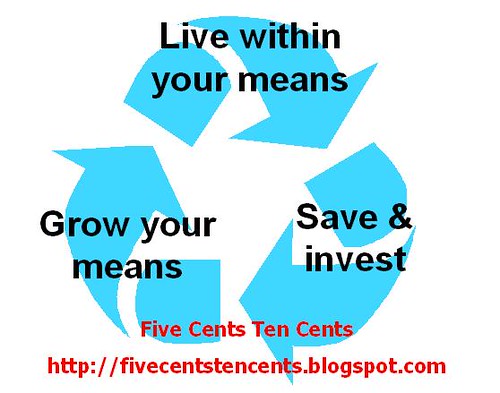
The more I write about financial freedom, the more I believe that the framework behind it is simple in theory but difficult in practice.

It is encompassed in the diagram above and has been mentioned many times in Five Cents Ten Cents.

The challenge facing many of us in terms of achieving financial freedom is in trying to work on all these three areas in our lives successfully. It is tough to tackle each of them but to be able to juggle all of them and to have successes in all requires patience, hardwork and a little bit of luck.

Live within your means

If you earn $1,000 a month, try to live within this amount. If you earn $3,000 a month, try to live within this amount. If you earn $5,000 a month, try to live within this amount. If you earn $100,000 a month (why would a Minister need to read my blog?!), try to live within this amount.

As a general rule, the more you earn, the more you should be able to save assuming your lifestyle habits do not change drastically. But the reality can be different as we suffer from lifestyle inflation where our expenditures quickly increase in the same if not higher proportion that our salary or business income increases.

Living within your means requires you to make conscious choice of NOT increasing your lifestyle expenditures drastically when your income increases. This is difficult for most people as many earn to spend and are trapped in this work-earn-spend-work-earn-spend cycle unconsciously.

Save and invest

In a period of low interest rates for fixed deposits and treasury bills, it is indeed hard to find risk-free or virtually risk-free investments that give you high returns. Nowadays 1% to 1.5% is the name of the game until MM Lee's "golden age" promise is fulfilled.

The save and invest part of financial freedom requires you to both live within your means to generate the investible savings. To some that is the easy part. The hard part is the investing. Too many of us have experienced realised losses in stocks and shares and other riskier assets. Investing successfully is HARD. Bad investment decisions can set you back YEARS in achieving financial freedom. But it can be done if you invest in learning as much about investments as you would into your favourite hobby.

Grow your means

Study hard. Get a good qualification and earn more money. That is still true to some extent in paper conscious Singapore. However, growing your means also requires you to develop your own inate talents, skills and abilities to the apex of your development potential. Learn more about your career prospects, the industry you are in. If you are in business, the external environment, the Michael Porter SWOT (strength, weakness, opportunity and threat) analysis to see how your business can survive and thrive given the operating parameters in front of you.

For those who are in employment, globalisation brings with it risks and rewards. Lifelong employment is gone. Look for lifelong employability or better yet, multiple streams of income.

What does it mean for you

Like an organisational excellence journey towards Singapore Quality Class or Award, we need to benchmark ourselves to the best standards for achieving our dreams of financial freedom. This benchmarking and more importantly, continuous learning needs to see us growing in all three areas:

  1. Live within your means
  2. Save and invest
  3. Grow your means

There is no shortcut. There is no magic bullet. There is no quick-fix.

We need to continue to live, breathe and dream financial freedom through the framework given.

It is continuous. It is a journey. It is within your realm of possibility.

Be well and prosper.

Thursday, February 28, 2008

Financial freedom: Revisiting the Lessons Learnt

Cloud-01

The more I travel along this journey towards financial freedom, the more the pieces are starting to click together.

What has happened in the last 4 years

My Excel worksheet skills are improving bit by bit as I use colour, conditional formatting, formulas and functions to jazz it up with both functionality and form to suit my approach towards tracking my networth and recording what are my investment returns (or losses!) for the last few years.

Hits and misses with stocks and shares

The journey is not always smooth. Some of my equity investments were more punts than long-term investments based on fundamentals and I had to take in some realised losses to trim my portfolio back to a more comfortable 28% cash and cash equivalents and 72% in equities as well as to remove under-performing shares bought at over-valued prices vis-a-vis the market and their fundamentals.

Developing small sources of alternate income

On the positive side, my forays into developing multiple sources of income is bearing modest fruit as AdSense helps defray the costs of broadband access. A bit of luck could be attributed to my foreign currency fixed deposit that yields a very high return relative to Singapore fixed deposit rates as I went in at a good exchange rate rather fortuitiously.

Understanding simple rules of thumb in finance

I also learnt more about the Rule of 72 which is a quick rule-of-thumb to determine how long your investment (or debt) doubles at a given interest rate. If you could get a return of 10% per annum compounded, it would take you approximately 7.2 years (72 divided by 10) to double your investment. If you could get a return of 2% per annum, it would take you closer to 36 years (72 divided by 2) to double your money. An 8% difference translates into 28 plus years to double your money.

Balancing between present wants and future needs

I also realise the importance of balancing my present wants against future needs and to live a little today and not be an absolute Scrooge when it comes to living within my means.

As I continue towards this journey towards financial freedom, it is with excitement and anticipation because my modest achievements have helped me gain a small degree of confidence about my ability to survive and thrive in Singapore Inc.

Paying off my housing loan

This is one of the most satisfying intermediate milestones in my journey towards financial freedom. I am thankful for my parents for their help in an interest-free loan which I have paid off in full. I don't claim to have been able to do it so quickly without their help. Their support advanced my plan to clear my loan by 2-3 years even though I have repaid them.

Understanding the fundamental principle behind financial freedom

There is no quick fix to achieve financial freedom. It is to live within your means. To save and invest prudently. To grow your means and ultimately to reach a stage where your passive income from your investment assets more than covers your living expenses. That is where you have "made it".

As with any endeavour worth pursuing, the reason why I have been able to achieve some of my intermediate milestones is focus. My home mortgage was cleared well before my retirement age because I was very clear that it was a high priority. Besides paying the daily living expenses, I channelled my savings, year-end bonuses and any form of windfall gains towards making periodic capital repayments. The cumulative effect of this was that with each capital repayment, the outstanding principle became lesser and lesser and the resultant interest expense also became lesser and lesser. Compound interest did the rest.

I had a clear time frame in mind and tracked my net-worth position from a consistent net liability all the way to the net asset position that I was in over those years I was repaying my loan. I did not own a car for more than a decade into working life and I continued to keep my living expenses low relative to my income level.

All this while I kept the concept of financial freedom in my mind. I filled my conscious with books on personal finance, on being frugal and sometimes bordering on stingy! ;-) I also focussed especially in the last year or so on health and to keep myself fit and healthy to enjoy a better quality of life and to keep medical costs low by seeing the doctor less.

Financial freedom is within my grasp. I am fairly confident that I can reach it with the support of my spouse, family and close friends who share my philosophy towards life. My time horizon is realistic. It is not a overnight journey. It is a journey measured by years. Measured by the growing up of my daughter (coming soon!). Measured by a corresponding improvement in the quality of life as financial burdens become less heavy over time.

I truly wish you can also join me in this journey, to find your own pathway towards your goal in financial freedom.

Be well and prosper.

Wednesday, February 27, 2008

Financial Freedom: Thriving in Singapore Inc.

It's budget time in Singapore as the Finance Minister has announced that Singapore has achieved a budget surplus of $6.4 billion in FY 2007/2008 resulting in the Government being able to give back some of the monies back to the rakyat (people) in the forms of various top ups and growth dividends.

In the land of plenty, more of the plenty goes to the TOP

The one thing I cannot wrap my head around is why in a country where we can invest billions in Shin Corp, Merrill Lynch, Citigroup and UBS, public assistance was only grudgingly increased from $290 to $330 (13.8%) while ministerial salaries went up 21% and mind you, it is 21% of 2-3 MILLION DOLLARS.

I can only draw one conclusion in my simple mind, that is, MAKE HAY WHILE THE SUN SHINES.

Singapore Inc is a place for you and your family to be financially free

Singapore Inc is a place to HUAT HUAT and HUAT. We are the epitome of social darwinism with those who are on the growing side of the income divide doing better while those on the losing side of the income divide suffer the full impact of the 6.6% inflation cushioned by the Governments "generous" handouts of GST rebates, growth dividends and top-ups.

Forget charity. Forget sharing the pie. Forget lending a helping hand.

Our country's values are greed, avarice and materialism. Money (and connections) talks. Everything else comes secondary. In a place where welfare is a "dirty" word, the only welfare I see is to take care of my own personal welfare.

In this quest to be on the winning side of the growing gini coefficient, I have decided to really focus and channel my energies into my own family and to achieve financial freedom LONG BEFORE THE STATUTORY RETIREMENT AGE.

CPF Life should be irrelevant to me as I intend to have passive income exceedingly my lifestyle needs before the mandatory retirement age.

Why such selfishness and focus on yourself?

For too long I have also led to believe in a kinder, gentler Singapore. A Singapore where the national pledge means something. The reality I see with my very own eyes told me a different face of Singapura.

2.5 years of full-time National Service in a combat unit gone. 10 years of annual uninterrupted reservist cycle of 7 high-key in-camp training (ICT)and operational duties defending the country and 3 low key ICT spent crawling through mud and drains in an assault course. For what? To grow the GDP so that our leaders can enrich themselves whilst letting Singapore sink in the population increase that sees us to hit 6.5 million eventually from countries such as China, India, South-east Asia?

Even MM Lee Kuan Yew himself admitted that many PRC take Singapore PR status as a stepping stone towards emigration to the US, Australia and other more developed countries.

The soul of singapore is Financial freedom

The message has never been starker now. In the land of plenty, equality takes back stage because we are a winner takes all society. The rich WILL get richer and the poor can go eat unbranded bread and unbranded rice as PM Lee admonished us that "Bread is bread and rice is rice". That's "rich" coming from someone earning $3 million a year.

Why do you want to achieve financial freedom?

I want to achieve financial freedom because I see this country as what it truly is. A place to make money and a place to gear up your children to take on a brave new globalised world where making money through value-creation in the new economy is the order of the day. Forget nationalism, patriotism and all the other idealogical 'isms out there.

The State expects you to take care of yourself. So you should listen to the State and take care of yourself but getting yourself out of your housing debt. Get out of your car loans asap and especially your unsecured credit.

Improve your means, live within in and save and invest. Grow your investible assets to the point that the passive income generated from your investible assets is more than enough for you to live on. When you reach that stage, you are financially free. You can do anything you want then because this country will WORSHIP you for your contributions to GDP through GST, ERP and other fees and charges.

There is no capital gains tax and since the abolishment of estate duty, you cannot take all your wealth with you but you can give it ALL tax-free to your next generation.

Isn't Singapore a great nation for financial freedom?

Be well and prosper.

Tuesday, February 26, 2008

Financial Freedom During Inflationary Times

Singapore's inflation hits 25-year high of 6.6%

5c10c_26feb2008

The headlines from Channelnewsasia says it all. Our inflation rate has hit a high of 6.6%!

The combined effect of the 2% hike in GST, global commodities price increases as well as increase in annual value in properties and oil makes the inflation rate much higher than any decent risk-free returns you can obtain from safe investments.

Your purchasing power is shrinking right now

Some people advocate more spending given this low interest rate regime coupled with inflation destroying any interest gains you get from the miserable fixed deposits or treasury bills yielding 1.35% to 1.5%. Those who believe in a live for now approach to life feel that what's the point of saving what you are getting a negative return of 5.1% (assuming 6.6% inflation and 1.5% return on fixed deposits). So might as well spend.

I choose to see it the other way. Because your purchasing power is now squeezed by inflation, you have to be more concerned about how to stretch that dollar you earn.

Living a frugal but full life by choosing to buy housebrands;  consuming my rolled oats every morning from Mondays-Fridays; not spending much of clothes, shoes and other accessories continue to be my lifestyle. The sad fact of life in Singapore is that inflation hits the poor harder as income statistics have shown that the higher income earners are getting higher wage increases compared to the poor.

The system is against you

The Government has contributed to part of the problem as the 2% GST hike was imposed as a matter of fiscal policy. Even though GST rebates and some of the growth dividends and tax rebates will return some monies back to taxpayers, the taxpayer loses out. He loses out because he gets hit with the inflationary pressures all the way from the time prices increase but will only receive the rebates LATER, after his monies was taken away from him UP FRONT. If you understand the time-value of money, then you will know that money now is worth more later due to interest. Thus, the Government imposed the 2% GST hike that affects us up front but we get the rebates much later, losing out through the time value of money.

What can you do to fight the inflationary pressure?

Under this unrelenting pressures of inflation, in a time when ministerial salaries are increasing at a higher rate than public assistance, the brutal truth of living in Singapore Inc is that you need to look out for yourself and your family.

Singapore Inc in its glory is ALL ECONOMY and NO SOUL. GDP growth at all costs is the name of the game when you see through the policies being promulgated at all levels. In the end, only your own financial freedom matters because it is the way that allows you to decide how to live your life without worrying about inflation and cost of living.

To be above the inflationary pressures is to move yourself from a wage earner in the rat race to a capital owner with income producing assets. Attaining financial freedom puts you beyond the worries of a 6.6% inflation because you investments are already putting you on a virtuous cycle of passive income growing your investible savings upwards.

Live within your means.

Save and invest.

Investment prudently.

Grow your means.

Be well and prosper.

Saturday, February 23, 2008

Financial Freedom: Growing your multiple sources of income

Many of us have only employment income

I read Robert G Allen's book "Multiple Streams of Income" where he talks about how you can go about building financial security by diversifying the sources of your income. Most of us only have one main source of income and it usually is our employment. Others may invest their savings into investments such as stocks and shares, fixed deposits and treasury bills.

More savvy investors may venture into property for rental, into commodities and other types of asset classes.

How to go about developing multiple sources of income

The quick-win in going about developing your multiple sources of income is to start with what you know, i.e. to live within your means so as to generate investible savings that you can put in a fixed deposit, treasury bill or even a cash fund. While these truly bring your passive income, the current low interest rates of 1% to below 1.5% means that you have to build up a large pool of capital in order for 1% to mean anything significant to you.

In order for you to seriously start developing multiple sources of income, you must break free from the mindset that you job is a given. Today's age of globalisation means that our jobs and our organisations are subject to the ruthlessness of market competition and consumer trends that can result in our organisations not being in existence in 10 years' time.

Stay in your job whilst it provides you with a steady paycheck. But whilst you are gainfully employed and using your monthly savings to build up your investment assets, consider too how you can make use of your skills, talents and abilities outside of your working hours.

Monetising hobbies

I have taken up AdSense as it helps me monetise my hobby of writing blogs and publishing them on the web. The root of my ability to write and to use internet technologies started not recently with my blog in early 2007 but rather back as early as 1996 when Cyberway Internet (now Starhub) was in existence and I signed up for my first dial-up at 33.6kps internet access package. Now I am on Starhub Maxonline at a blazing speed of above 4Mbps!

It was because I had embarked into the new world of the World-Wide-Web as well as did my very first homepage then that I became familiar with web publishing. I took a break and came back in force in 2007 using some of the very fundamental skills of using Lviewpro (graphics editing software) plus the templates provided by blogger to publish my content online.

With the Googalisation of the internet, AdSense has helped me pay for my broadband bills although it is still a long way before it can allow me to not work for a living.

Building YOUR second career while you are still on your first

Most of you wouldn't mind working until you reach the statutory retirement age of 62. However, you may not be given that choice because organisations can outsource, downsize, be sold off in mergers and acquisitions or you could find your skillsets redundant in today's world.

What can you do about it?

This is where building your second career while you are at your first will help give you more options should your first career ever plateau or worst, be consumed by the forces of globalisation.

I have been building up my possible second career by joining toastmasters. Besides wanted to improve my networking and public speaking skills, I saw toastmasters as a way to build up realy knowledge and expertise in becoming an independent trainer or consultant. This is because I have additional specialist domain skillsets beyond public speaking. While I can teach or share my experiences as a public speaker and impart public communication skills for a second career, I can also be a trainer based on my experience in my chosen profession. Such second careers have a longer lifespan and work in favour for those who are experienced (or older in age!) because the conventional wisdom is that gurus or trainers tend to be old. So this form of a second career is relatively more age-resistant as compared to other careers.

Learn more and take action to build your first multiple source of income

If you are serious about building up multiple sources of income, I urge you to read Robert G Allen's book. You can find it in public libraries and use it to expand your mindset towards another way to help you achieve financial freedom.

Be well and prosper.

Friday, February 22, 2008

Guest Post by Sgmusicwhiz: His thoughts on financial freedom

As part of making my blog more interactive and to invite views from other bloggers passionate about financial freedom, I have asked musicwhiz, an online blogger who follows my blog (as I do his), to do a guest post by featuring his comments into a post in today's entry.

He shares my passion in financial freedom and is also striving like many of you to reach your dream of achieving financial freedom way before the statutory retirement age.

Here are his insightful comments!

Enjoy.

Be well and prosper.

=====================================

musicwhiz said...
 
Hi Panzer,

Another good post and it is good to have a constant reminder of our goals. It is good that our goals are aligned on this aspect, except that I do not have any child arriving whereas you do ! Haha.
 
By the way, let me take the opportunity to congratulate you on your soon-to-be-parent status ! It cannot be easy to be faced with the prospect of a radical change in lifestyle but I can see that your goals are firm, so you will be able to achieve financial freedom someday soon.
 
Come to think of it, not many of my friends use this term "financial freedom". Most of them tend to talk about tomorrow, next week or next month and what they plan to do with their time. But none of them really seriously discuss several years down the road and how they would like to expand their wealth. Some talk of migrating, others about having kids while still others wish to enjoy life by spending on depreciating assets.
 
Yet I would implicitly assume that each of these decisions should be supported by adequate financing, otherwise they may (literally) fall flat on their face !
One thing I have noted is that my friends have a lackadaisical attitude towards investing and treat it as a "if it works, good ! If not, then heck it" matter.
 
Yes, some are very thrifty and save a substantial chunk of their income; but the true way to attain financial freedom is more than saving. It's about using money to grow more money and investing is one of the best methods for this. It may sound preachy but I have realized this the hard way after struggling for 7 years to build a decent savings balance.
 
Just by investing for the last 3+ years, I have managed to almost triple my total assets, though my mortgage loan still remains my single largest sole liability. Without investing and saving, I think I would not have managed this; thus I would like to provide a living example of how saving, living within your means and investing can help to grow money more quickly.
 
In a time of falling rates (SIBOR is around 1.44% as I type this), we cannot rely on FD or savings accounts to beat inflation. Thus, I choose to place my money in equities and high-yield instruments to maximise returns. Time will tell if I had made the right decision, but it sure beats being "safe" and leaving my money to rot in a bank account. 
 
To end this long comment, I would like to reiterate that if only more people would be serious about investing and make capital preservation the central tenet in their investing philosophy, then they would discover that they can make money by NOT losing money.
 
Sorry for the long "essay", but hope that I managed to share something useful for you and your readers.
Cheers,
 
Musicwhiz

Thursday, February 21, 2008

Financial freedom: what others think and feel

If you have been reading my blog for some time, you will realise that the reasons surrounding why I am so focussed on financial freedom come from a few incidents in my life. These incidents helped me reach an epiphany when it dawned upon me that my financial security under the old paradigm of work-earn-spend-work cycle was an illusion. Hence, financial freedom really is within my hands to control by managing how I spend or save each dollar I earn.

If you are reading my blog for the very first time, welcome, and let me share with you what others think about financial freedom. I follow this blog by Danny Choo, a well-known Otaku and web services developer who happens to go around in Star Wars Storm Trooper armour throughout the streets of Tokyo. He studied in UK and majored in Japanese hence decided to work and live in Japan. He also shares about his thoughts about life and why he drives himself so hard to make money running his own business in Web Development.

I find that he is being quite honest when he says that MONEY brings financial freedom for him to pursue the kind of life he wants in terms of work, play and family. His hard work and perseverance resulted in him owning a three-storey house in Tokyo. Material accomplishments aside, he pursues a life filled with meeting many interesting people in the Japanese online web services eco-system and he is living the life that he wants to live.

Do give his post a read if you are a bit tired of Panzer's rattling on and on and on and on about financial freedom as Danny writes with a sense of humour as well if you understand his Otaku jokes weaved into the tapestry of his posts.

Be well and prosper.

Tuesday, February 19, 2008

Financial freedom: To decide IF you want to work


If work is your hobby, you never have to work a single day in your life!
I had a conversation with a relative of mine who has his own business and enjoys doing it. He is debt free and enjoys a comfortable life. For him, financial freedom is not so critical because he likes what he does and enjoys interacting with his customers. To him, work something that provides well for him and his family and he will continue as long as he can.

I too would like to be in an organisation where my skills are valued, my work is value-creating and where the remuneration package is fair. But it is a challenge to find a job that is able to satisfy on so many aspects of Maslow's hierarchy of needs. For the record, my job isn't that bad and the remuneration is decent for the regular hours I work. I don't need to travel for overseas assignments. I do count my blessings for this current job.

Perspective on work-life changes with parenthood
I realise that as I embark on a new phase of life to that of being a father, my perspective of work-life balance changes. Being a parent means you have dependents to support. Being a parent means you come 2nd to your child and spouse. Being a parent means you no longer can be selfish and think only of yourself because you child relies on you for her every need.

Being a parent means you have to be there physically and emotionally for your child and yet deliver on your job through whatever means available, phone, remote VPN back to office mail servers and the like. As the responsibilities of being a parent dawn upon me, I start to go to work with a renewed vigour, to be early for work as I also need to go home on time to prepare for my daughter's impending arrival and to support my spouse who will be doing most of the actual work in bringing my daughter to this world.

But as I continue with my job as the means to build up my financial freedom, I begin to explore even more ways that I can be financially free but continuing with the fundamentals (which some may have heard ad-nausem!) :

  • Live within your means
  • Save and invest
  • Grow your nest-egg
  • Expand your means
My weekend blogging now has become a pleasure rather than a chore because it brings me closer to my destination. I also enjoy the process of writing, thinking and documenting my thoughts down for the time when my memory starts to fail me.

Financial freedom means different things to different people. It is for me, the ability to decide IF you want to work. That, truly is what it is all about.

Be well and prosper.