Five Cents Ten Cents

Showing posts with label save money. Show all posts

Wednesday, June 27, 2007

Money savers: see less and you buy less

In an earlier post on "We covet what we see", I touched on how you are programmed to want more than what you really need. Underpining this behaviour is how your desires are stoked by the images you see trying to get you to fulfil that perceived need or want.

If seeing is believing and making us buy stuff that we don't need. Then the way to save money is to see less so that we will buy less!

How does this work
You receive tonnes and tonnes of mailers from your credit and debit card companies all the time filled with glossy brochures and incredible good deals and discounts for fashion items, accessories, jewellery, electronic gadgets, toys, furniture and so on. In order for us to curb our unnecessary spending, you can slowly wean yourself off this diet of glossy brochures and glimmering big offers by putting them aside and not reading them when you first receive them. Just put them to one side and wait for the rag-and-bone man or your charity organisation to come for their monthly collection of old newspapers and magazines and put these brochures together with the pile and recycle for a greener world!

Cut down stimuli to your brain to make you buy stuff
If you know how the brain works, our desires tend to be activated by the images we see and the thoughts generated to get us to consume this product or that service. This is what advertising is all about, trying to change our attitudes and preferably our buying behaviour towards a particular product or service. For you to save money and cut down on spending, you have to consider cutting down the amount of stimuli your brain is getting about consumption.

Go on, try out this techique for one week and report if you have had any success in being less inclined to buy stuff you don't need!

Be well and prosper.

Tuesday, June 26, 2007

How to save money daily?


Have you heard of this saying that, "a dollar saved is a dollar earned?"

Saving money is making money. By choosing to go for more economical ways of doing about your daily lives, you can save a lot of money. A forummer by the name of homer123 gave some of his suggestions he read from another forum many years back:

"1. spend more time reading and exercising (jogging, cycling--free anyway) to keep fit to avoid unnecessary illness instead of getting involved in bad activities like drinking or chioning.

2.Avoid any temptation to spend-avoid the shopping centres. Each time, prepare a grocery list and just go to the nearest provision shop and get them... the longer you linger... the more itchy to spend.

3. Recycle/reuse waste water. When taking shower or bath daily, stand inside big bucket and collect bath water running down the body inside bucket. Collect all washing machine rinse water. Use them to flush toilet or wash floor. Enough to last many toilet flush. Save water.

4. When washing hands, use water from container instead of water flowing from tap.

5. Place 1 litre bottle inside toilet cistern to limit water flushing quantity.

6. Let your tap drip overnight into a pail... free water... the meter can't detect small movements... good for mopping floor.

7. Learn to fish. I spend my free time fishing ..The amount of fish I catch every month is enough to last me for a while ..Provide good protein and they are free!

8. Plant some of own veggie. I live near Malaysian Railway track..The land along it is unused and I cleared some plot to plant my veggie.I tried to plant those that grow easy...like sweet potato or gourd-type veggie

9. Buy good secondhand electrical good when possible. Save money.

10. Empty refrigerator and buy smaller fridge as much as possible. Eat 2 meals a day and stay thin. Buy only when needed, do not overload fridge.

11. Short distance travel use bicycle. Stop using bus/mrt or taxi. Save travel expense.

12. Use company toilet to bath or s#$% everyday. Save home water usage.

13. Charge all your batteries in the office (save elec bills)

14. Surf in the office... or get the cheapest rates

15. When purchasing computer. Don't buy brand new. Buy secondhand, it is just as good if for normal internet surfing purpose.

16. Cook yourself and Bring own lunch to work...

17. DON'T buy any drinks, even softdrinks cos' they're the most unworthy ones... bring a sports water bottle... Keep one in backpack ... one day at least save $2-$3 on drinks

18. Terminate your Handphone line. Get a pager and a phone card, it is cheaper. It may be inconvenient but you are still contactable.

19. Stop using aircon. Buy electrical fans. Save electricity.

20. Install window film or tinted glass at home to keep heat away from home. Keep house cool and bring down air-con or fan electrical bill.

21. Don't buy newspaper..Read from CC or library.

22. Wear your cloth and shoe until there is a hole before buying a new one."

Do you have your own money savers to contribute? Leave your suggestions in the comments section!

Be well and prosper!

Sunday, June 17, 2007

Sign up now for your GST credits!

Here is a gentle reminder for those of you who have not signed up for your GST credits to do so before 25 June 2007 via ATM or internet so that you can receive it by 1 July 2007!

Friday, June 15, 2007

How to monetise junk in your home using Yahoo Auctions!


You bought that game console, original book, collectible toy 1 year ago and now you do not use it. You realise that item you had purchased and used for a while now does not have much use to you. But do you know that it may be the perfect item for a student who is on a tight budget? A working adult who wants to make his money stretch and even second hand goods dealers who want to buy second hand items in good condition?

Welcome to Yahoo auctions!

What are internet auctions
Internet auctions are nothing new and they have been around for some time. I even remember attending a talk way back in early 2000s where I met the founders of Interauct!-- a local auction site that positioned themselves as the "eBay of Singapore". Sadly, I just went to their website recently and the website is a pale shadow of its heydays where there were thousands ot items listed and bidded daily. The entrance into the Singapore market by the big boys like ebay and Yahoo auctions have muscled in and now these two websites are where the buying and selling are taking place.

Why would you want to consider Yahoo Auctions?
It's free. :-)

Ebay charges a fee for users to list and sell their items online. However, Yahoo Auctions still does it FOR FREE! Where do such opportunities still exist?

Listing what is a piece of useless junk or superfluous item in your home inventory and selling it allows you to monetise what is taking up precious space in your home. The cash flow released back to you allows you to save and invest and then allow you to buy that next item or gadget (and of course become a piece of useless junk again in 1-10 years' time! ;-)) again. The cycle of continues....

So what do you need to do to get on Yahoo Auctions. First of all, you may want to create a Yahoo ID/email that you can use for various Yahoo services. Secondly, you can then register for Yahoo Auctions, verify your credit card info/paypal and you can start listing your item and selling it for a few dollars to add to your retirement fund!

The fun part about Yahoo Auctions is that you learn how to package, market and target your Ad to make it appealing for potential buyers to bid for your item. This is teaching me a little bit more about being a better sales person and is a useful skill. Given that many of you out there have broadband access already costing you $30 to $60 a month, why not leverage on it, look at what you can sell, what is sellable in today's market and start monetising your junk using Yahoo Auctions!

P.S. I do not get a commission for recommending Yahoo Auctions but a friend of mine who is a experienced online seller of collectibles and jigsaws has tried both Yahoo Auctions and Ebay highly recommends Yahoo Auctions if you intend to sell to the Singapore market.

Be well and prosper (a little) selling stuff online. :-)

10 ways of using less electricity to save money


Singapore Power has just announced that average electricity tariffs will be revised upwards by 8.83% for the quarter 1 July 2007 to 30 September 2007. What good timing! 1 July 2007 is also the date for the increase in Singapore's goods and services tax from 5% to 7%, a 40% increase.

What can you do, as a hapless consumer who can only buy retail electricity from Singapore power who is the only provider for domestic consumers of electricity? You need to tighten your belt. I need to tighten my belt. We all need to tighten our belts by conserving our electricity use. How can we save money by using less electricity?

1. Switch from air-conditioning to fans
Airconditioner units use up massive amounts of electricity. Turn to using fans to help cool yourself down during this hot June weather

2. Visit libraries and shopping malls more often
Use less of your own fans/airconditioners by leveraging more on those provided by public places. It helps you to cut down your own electricity use since you are cooling down at those locations.

3. Have more cold showers
Before you switch on the water heater, consider bathing in cold water as the weather now is so hot!

4. Switch from CRT monitors to LCD monitors
LCD monitors use less electricity thatn CRT monitors so do your part for the environment, and you electricity bills as LCD prices are falling.

5. Drink more plain water at room temperature instead of chilled drinks
Your refrigerator is the next biggest consumer of electricity in the house. Drink more water at room temperature instead of chilling them which consumes electricity.

6. Wash your clothes with a full load
The washing machine also sucks lots of wattage from your electricity mains. Ensure optimal capacity before running the washing machine. Helps to save water too!

7. Switch off and unplug unused appliances
Appliances that are not used, e.g. computers still draw small amounts of power even if they are switched off. Switch off the power outlet and unplug the appliance.

8. Sleep early
Use more of natural light and less electricity for lighting and cooling by sleeping early. Reduces the need to rely on electricity powered illumination and fans/airconditioners.

9. Iron less frequently
Make use of the iron by ironing more clothes at one go to maximise the use of the iron.

10. Watch less TV read more books
Read more books and magazines (free if borrowed from the library while you are cooling off) and switch off the TV earlier. :-)

Do give your own tips too in the comments section and all the best in your efforts to save money by using less electricity!

Wednesday, June 6, 2007

How to save money attending quality courses on public speaking and communication


IMG_6337
Originally uploaded by panzergrenadier
Have you ever received unsolicted emails, flyers or brochures advertising training courses before?

Receiving training flyers and brochures
I'm sure many of you have received such invitations! Some of them are quality courses, some of them are mediocre but most of them costs considerable amounts of monies.

In my organisation, the fax machine regular spits out unsolicted faxes to attend public communication courses for about $400-$500 a day conducted by overseas trainers. That's the going rate for attending professional courses on how to be a better speaker and communicator.

Open secret about where to get value-for-money training
Here's a open secret I would like to share with you about public speaking and communication training. You can avail yourself to quality training by experienced public speakers (and many are full-time trainers by profession!) for as little as $0.50 per day! For the price of less than a cup of coffee or tea, you can be trained by experienced toastmasters by joining a toastmasters club!

Why join toastmasters
If you ever have a problem:
  • articulating your ideas to your boss, supervisor or colleague;
  • explaining something to your spouse, children or family member;
  • convincing someone of the validity of your ideas, your approach, your method;
  • standing in front of your customers, clients or business partners;
  • making a thank-you or acceptance speech at a dinner, a function or a wedding
Join toastmasters!

I can say, sincerely from the bottom of my heart, this is not a marketing gimmick or ruse. I have been a toastmaster for close to 5 years and I have moved from being a Competent Toastmaster to a Competent Leader to a Advanced Communicator Bronze. I have participated in Humourous Speech Contests, Evaluation Contests, International Speech contests. And I have won contests at the Club, the Area, the Division and competed among the best in Asia at the district for the Table-Topics contest.

Toastmasters provides value-for-money training
Toastmasters works and is a value-for-money programme that teaches you:
  • Fundamentals of public speaking
  • Overcoming fear of speaking in front of an audience
  • How to think on your feet and respond to virtually any topic that is thrown at you
  • The secret to crafting any type of speech
  • How to capture the audience's attention
  • And much, much more
So long as you are serious about becoming a better speaking. So long as you are willing to invest at least once a month (if not more often) to attend a club meeting. So long as you are willing to attend so many education workshops on public communication and leadership for as low as $8 for a 2 hour workshop, toastmasters is for you!

Special offer for visitors to fivecentstencents blog
I invite all visitors to my blog to attend the Open Alumni Toastmasters Club's Education Workshop on THE ART OF PUBLIC SPEAKING at a discounted rate. Just quote this code word "fivecentstencents.blogspot.com" and you can bring along a friend to this meeting free-of-charge (buy 1 get 1 free!).

Part I: THE ART OF PUBLIC SPEAKING
  • Learn the skills and techniques of public speaking to boost your career and life
  • Learn how to control the butterflies within you to impress, persuade and to inspire
Part II: THE ART OF CONFIDENT LIVING
  • Learn about skills and techniques of living confidently
  • Learn about how to expand your life exponentially
ABOUT THE SPEAKER
Patrick Chang, currently the Membership Director of Asia Professional Speakers - Singapore, is a public speaking trainer with more than 20 years of training experience. He is the founder of SimplySpeaking, an organisation specialising in public speaking and presentation training. In 1998, Patrick began providing public speaking training and has since trained more than 1000 participants including students, undergraduates, school parent volunteers, teachers, corporate executives, business owners, statutory boards, MNCs, community clubs and toastmasters clubs.

Date
: 14 June 2007 (Thursday)
Place: The Corporate Office
(Near Tanjong Pagar MRT and Raffles Place MRT)
Level 9, Great Wall Room
138 Robinson Road
Singapore 068906
Time: 7.30 pm to 9.30 pm
Investment: $8 only (Each paying participant can bring 1 friend for FREE! Just quote fivecentstencents.blogspot.com)
(Light Refreshments will be served)

Tuesday, May 29, 2007

How to gain health and save money by cooking

Cooking is an under-rated skill in Singapore. If you believe in the concept of specialisation of labour, then you would think that it's more efficient for working professionals to concentrate on working and earning money and buy cooked food for our meals.

Well...yes and no.

While Singapore hawker fare is relatively plentiful and inexpensive, the true cost of not cooking is reflected in our health. In general, eating out can be more costly in the long-term because of the health implications.

Hawker food (and even restaurant standard) usually is:

  • Not fresh
  • High in sodium, oil, sauces
  • High in saturated fats
  • Bad bad bad for your health
So what's the alternative?

Learn to cook.

I used to be those who didn't know how to cook. Then I slowly picked up the hobby of cooking over weekends by learning to buy the ingredients such as meat (chicken, fish, pork) , vegetables, spices and sauces etc. Learning how to steam, stir-fry, boil simple dishes and soups.

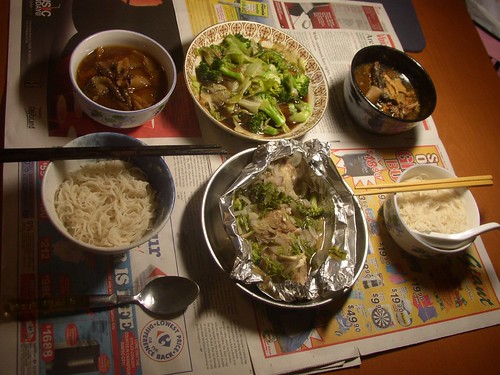
Hey, isn't this a personal finance blog rather than a cooking blog? You're right, this topic is relevant to our personal finance because cooking can save you money as compared to restaurant meals. Recently I bought a whole chicken (1.1kg) for only $2.90! Wow... That's enough to feed me for 3-4 meals as I can chop the chicken into 3-4 portions, freeze most of it and cook each portion for a meal. Coupled with quick stir fry of spinach + shitake + dash of seasame oil, light and dark soy sauce, chopped garlic and onions and we have a simple nice meal all whipped up in less than 40 minutes.

The one thing that I realised from cooking my own meals is that it's very much healthier as you can control how much of salt, fats and oils you add to your dishes. In addition, the fresh onion and garlic are natural anti-bacterial agents which help to kill nasty germs in your body helping to boost your immunity.

Cooking is also a survival skill as you learn how to choose what you want to put into your mouth instead of relying on someone to cook leftovers and charge you $3-4 for that.

Be well and cook your own healthy meals towards financial freedom!

Tuesday, April 17, 2007

Bring Your Own Portable Hydration Unit (Water Bottle)

Saving money is sometimes about pinching pennies, other times it is pinching pounds! :-)

One of the great money saving techniques which has a strong health benefit is to bring your own (BYO) water!

All of us have to drink water. H2O gives us life and 2/3s of our bodies are actually made up of water. Did you ever stop and count how many soft-drinks or coffee/tea that one consumes that makes up our fluid consumption? If we drink say, 8 glasses a day and drink 1-2 glasses of water, another 1-2 softdrinks and the remainder through milo/coffee/tea etc. How much would that cost is a typical work-day (assuming you have to pay for it yourself?)

2 glasses of water : $ negligible
2 cans of soft-drink: $1.20 per can = $2.40
4 cups of coffee/tea: $0.90 per cup = $3.60
Total daily expenses on fluids = $6.00
x 20 days a week = $120 a month
x 12 months in a year = $1,440.

Wow... That means we could potentially be spending about more than a thousand dollars a year on soft-drinks! The good news is that there is an alternative we can turn to, good old PUB water direct from the tap or from water coolers. Generally, water is "free" to the consumer if you get it from public water coolers or if your organisation provides water coolers for one to fill up one's bottle.

Invest in a good Lexan/Rubbermaid/SIG type of water bottle to the size of your preference and you are good to go in your quest to save money!

Hydrating yourself throughout the day makes you feel less hungry and you tend to eat less. Drinking water also helps moistern the throat and for those who need to speak a lot at work, this will help your voice last longer. Also, drinking water helps the circulatory and lymphatic systems and waste products in our body makes. The amount of money we save from buying softdrinks and coffee/tea would also offset our investment in the water bottle! It's a win-win-win strategy :-)

Of course, that does not mean we have to swear off softdrinks and hot beverages outside. Simply carry a water bottle around and reap the benefits of spending less money on purchasing them. When I was in New York, I realise most New York office workers actually walked around with their Evian/Dasani water bottles and it was part of their culture.

So let's bring out our water bottles and say "cheers" to the money-saving benefit of bringing your own water bottle.